Style collection
Organic Modern Christmas Decor
Create an organic modern Christmas look with sculptural greenery, natural texture, quiet contrast, and carefully edited holiday accents. The most convincing holiday rooms begin with a warm, contemporary holiday home where natural forms provide most of the visual interest. Rather than adding decorations to every open surface, start with the architecture, the way the space is used, and the views that connect it to nearby rooms. A considered palette of bone, mushroom, cedar, charcoal, and aged bronze creates continuity, while raw wood, linen, handmade ceramic, wool, paper, and realistic greenery bring the depth that makes a seasonal arrangement feel collected. Use the ideas below as a flexible framework: adjust the scale, edit what you already own, and leave enough breathing room for the room to remain comfortable through December.
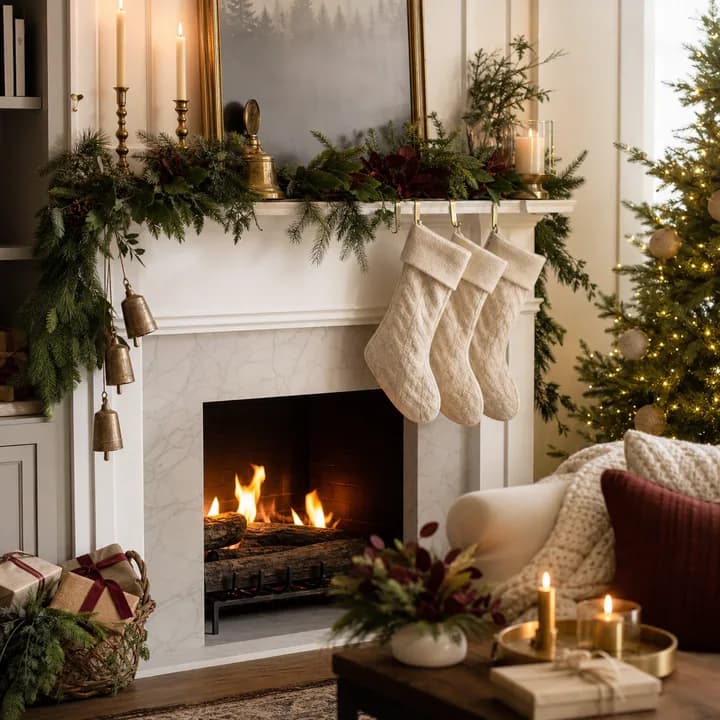
A considered approach
Start with the room, not the decorations
The strongest direction for this space is a warm, contemporary holiday home where natural forms provide most of the visual interest. Take a photograph from the main doorway before you begin; it will reveal whether the visual weight is balanced and which surfaces already feel active.
Choose fewer, larger gestures, balance curved forms with clean lines, and repeat natural texture across adjacent rooms.
The visual edit
Color, materials, and proportion
Palette
bone, mushroom, cedar, charcoal, and aged bronze. Let one tone dominate and use the others to create rhythm rather than equal blocks of color.
Materials
raw wood, linen, handmade ceramic, wool, paper, and realistic greenery. Combine matte, soft, and lightly reflective surfaces so the result has depth in natural and evening light.
Placement
Choose fewer, larger gestures, balance curved forms with clean lines, and repeat natural texture across adjacent rooms.
Four directions
Styling ideas to make your own
Use one idea as the lead, then borrow smaller details from the others. A clear hierarchy keeps the finished space calm.
Sculptural branch arrangement
Build this moment with the guide’s bone, mushroom, cedar, charcoal, and aged bronze palette, then edit until the surrounding room still has space to breathe.
Textural neutral tree
Build this moment with the guide’s bone, mushroom, cedar, charcoal, and aged bronze palette, then edit until the surrounding room still has space to breathe.
Stoneware candle grouping
Build this moment with the guide’s bone, mushroom, cedar, charcoal, and aged bronze palette, then edit until the surrounding room still has space to breathe.
Simple paper ornaments
Build this moment with the guide’s bone, mushroom, cedar, charcoal, and aged bronze palette, then edit until the surrounding room still has space to breathe.
A useful edit
What to avoid
Too many tiny neutral objects can feel bland rather than minimal; contrast and scale are still essential. Before committing, step back to the doorway or imagine the object in daily use. That change of perspective usually makes excess scale, clutter, or impractical placement obvious.
Source with care
Recommended pieces for the look
Use these focused categories as a starting point, then compare materials, dimensions, care needs, and current pricing before choosing the right piece.
What to look for
Sculptural branch arrangement
Compare size, material, care requirements, current price, and availability to find an option that fits.What to look for
Textural neutral tree
Compare size, material, care requirements, current price, and availability to find an option that fits.What to look for
Stoneware candle grouping
Compare size, material, care requirements, current price, and availability to find an option that fits.What to look for
Simple paper ornaments
Compare size, material, care requirements, current price, and availability to find an option that fits.Helpful details
Frequently asked questions
How do I start styling organic modern christmas decor?
Begin with the main sightline and one clear focal point. Work outward from that anchor, repeat a limited palette, and stop before every surface is occupied.
Which colors work best for this look?
A balanced starting palette is bone, mushroom, cedar, charcoal, and aged bronze. Use the darkest tone to ground the arrangement, the lightest for breathing room, and seasonal color in smaller repeats.
How can I make the arrangement feel more natural?
Mix raw wood, linen, handmade ceramic, wool, paper, and realistic greenery. Vary height and direction, allow a little asymmetry, and avoid spacing every object at identical intervals.
What is the most common styling mistake?
Too many tiny neutral objects can feel bland rather than minimal; contrast and scale are still essential.
Can I create this look with decorations I already own?
Yes. Edit by color first, relocate pieces from other rooms, reuse bowls and trays as anchors, and add clipped greenery or ribbon only where the composition needs softness.